Ensuring Seamless Collaboration in Food & Beverage Industry

Innovation is very vital for the growth of any company. Anticipating and meeting the needs of consumer creates consumer trust and brand value. Behind a successful brand, there is a team of many individuals contributing with their expertise. However, these efforts from the team members are more often fragmented and results in lower performance and profitability.
The Benefits of Going Digital in Food & Beverage Industry-1

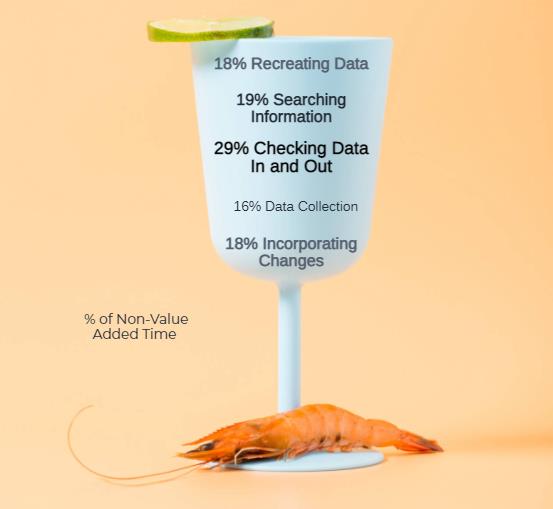
Individual departments perform tasks in silos and miss out on connecting with the other departments, which leads to a lot of non-value-added time.

The food & beverage industry, in particular, is facing the below challenges:

  • Coping up with health & wellness trends – There is a surge in demand for healthier products in the times of COVID-19. For companies, it has become a mandate to expand and modify the existing portfolios to support the demand for products that are natural, botanical & contain plant-based proteins. The formulation needs to be altered as the focus has changed from food to nutrition. Reduction of added salt, sugar, and fats is a must, and there is a need to come up with foods that nourish each body type.

  • The Benefits of Going Digital in Food & Beverage Industry-2

  • Ever changing consumer behaviour – The recent trends like an inclination towards Hyper-Local food and alcohol-free beverages are here to stay. Consumers are looking for new ways to engage with brands and aspire for products that could reflect their unique identity. Market needs are shifting faster than ever before, and companies must adapt quickly to deliver meaningful innovation as per the changing consumer preferences.

  • The Benefits of Going Digital in Food & Beverage Industry-3

  • Pressure of earning profits – There is growing pressure from investors to drive sustainable growth and increase profits. Also, the pressure of rising commodity and resources cost needs to be managed. Fragmented IT infrastructure and declining IT budgets are forcing companies to look for more efficient solutions.

  • The Benefits of Going Digital in Food & Beverage Industry-4

  • Production getting complex – Demand for more personalized products is leading to an increase in SKUs. Also, there is a pressure of coming up with new assortments with more channels to serve. Managing production complexity to provide the right product at the right time is critical.

  • The Benefits of Going Digital in Food & Beverage Industry-5

However, not all companies have the means & resources to manage these challenges in the most efficient way. It is high time for food & beverage companies to adopt the “digitalization” for product development to take innovation and profits to the next level.


The benefits of going digital in the food & beverage industry are as described below:

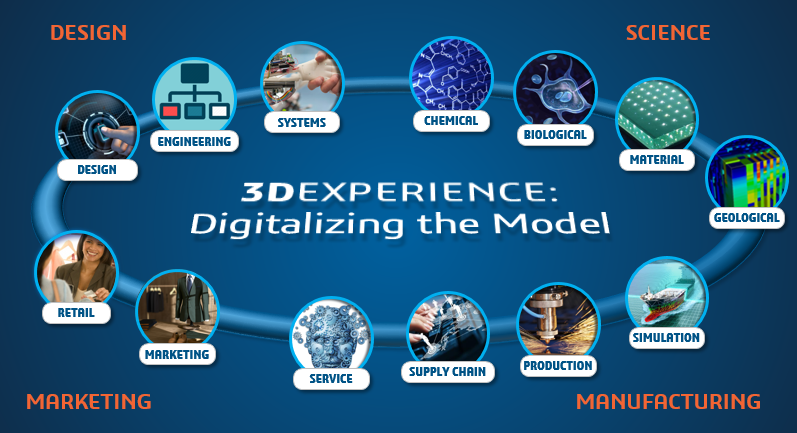
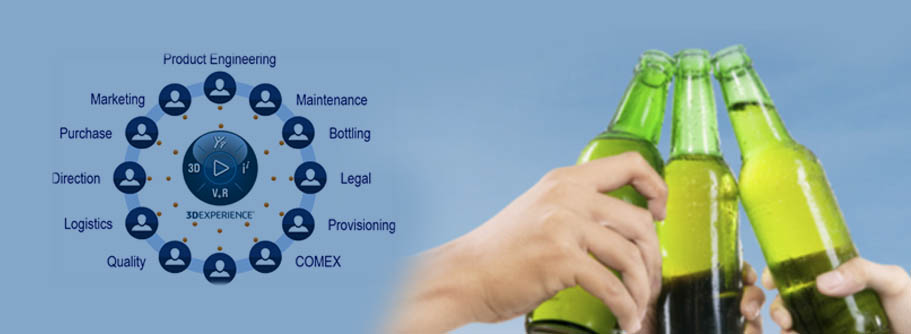
Seamless Collaboration – In the food and beverage industry, the multiple teams need to collaborate to bring new ideas, products and artwork to market. Gone are the days when companies could afford the inefficiencies and losing market opportunities from disjointed product data. The need of the hour is to tie product innovation, development and commercialization processes together with a holistic platform that provides multiple applications for continuity and connectivity of information, people, and processes.
The Benefits of Going Digital in Food & Beverage Industry-6

Developing a successful product that excites consumers requires an integrated approach across formula, packaging and labelling design.  Unfortunately, most companies support the development process with a patchwork of point solutions that are stitched together but not integrated, resulting in poor efficiency, product launch delays, and missed customer expectations.

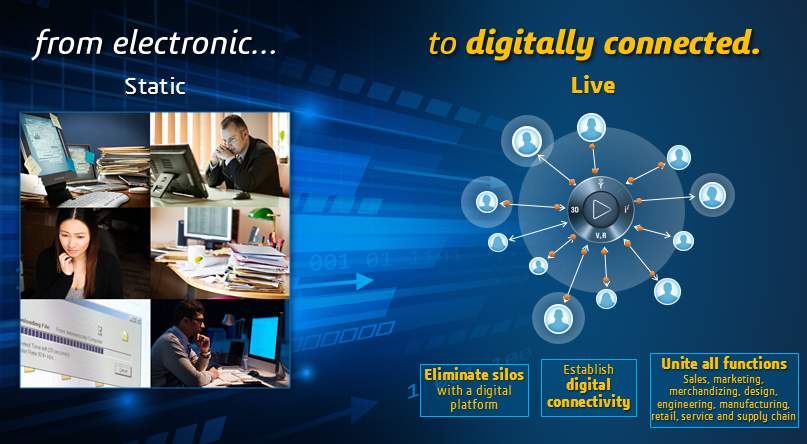
For an organization to manage its work smoothly, the disconnect between departments needs to be dealt with so that everyone has access to accurate and updated information in real-time on a single platform.


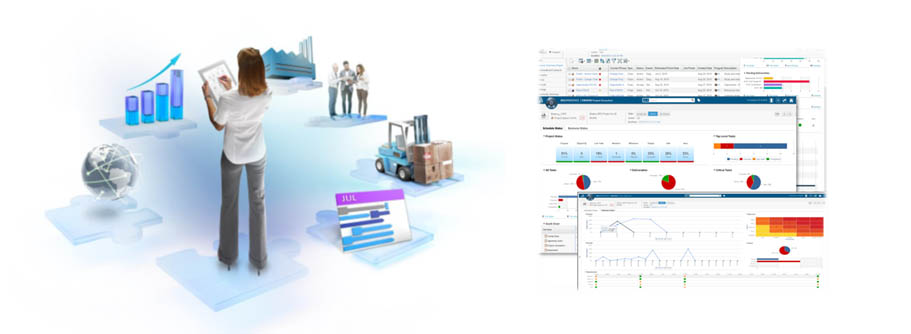
Integrated Project Management & Clear Business Dashboards Launching a new product to market is as fast as your slowest link is. Typically, the project managers who are deprived of the right system need to refer multiple systems and manually collect and collate project statuses from different stakeholders. With the adoption of an integrated project management capability tool, project managers can focus on actual project management activities like evaluating the project progress, identifying and reducing risks, and aligning resources to maintain or accelerate schedules.

When project statistics, assigned tasks, dependencies, risks status, timelines, financials, meeting minutes are all contained on a platform with established processes, managers can improve project execution and performance.
The Benefits of Going Digital in Food & Beverage Industry-7

Competing for new opportunities and growing faster than competitors requires real-time data and the insights it provides. Companies are pursuing greater speed, scale, and simplicity across every area of their operations. Real-time data is the catalyst making these three goals and many others possible to achieve.

 
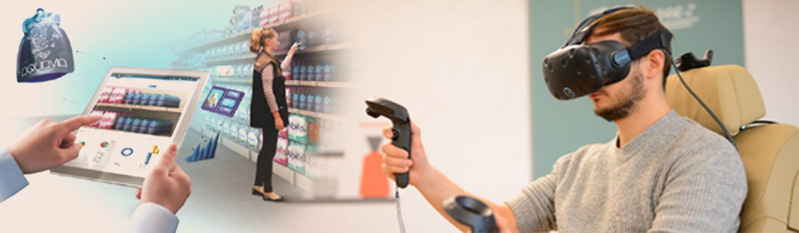
Immersive Virtual Reality – The need of the hour is to enable food & beverage companies to create high-end visualizations for interactive marketing and sales experiences. It is required to quickly create unique products, digital assets, images and videos to engage the customers with interactive and personalized product experiences. The companies also need to virtually bring together Brand Manufacturers, Artwork Studios, Agencies and Packaging Suppliers to accelerate breakthrough designs. With this, companies can shorten package design cycles, reduce costs, lower the possibility for production issues and virtually eliminate recalls.
The Benefits of Going Digital in Food & Beverage Industry-8

The era of static 2D planograms is nearing its end. By realistically simulating immersive, lifelike 3D store environments, food & beverage product brands and retailers can better imagine, validate and deploy winning shopping experiences while increasing product appeal, in-store execution, compliance, brand & category profitability and equity all while setting themselves apart from the competition.


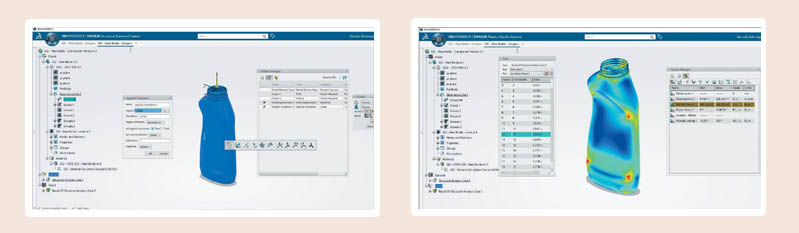
Eliminate the Prototyping – In the modern design era, leading digital tools introduce modeling and simulation into the design. These tools enable innovators to focus on developing the ideal solution for the consumer. Automating the impact analysis of design decisions gives them the ability to iterate more freely.

To create better product and package designs, expensive prototyping can be eliminated through modelling and simulation. By using digital tools, identifying and eliminating mistakes in the digital stage is done, when changes are least expensive. Companies can digitally model and simulate the product, before committing a dime in the physical world.
The Benefits of Going Digital in Food & Beverage Industry-9

To sum up, food & beverage companies need to adopt digital solutions to take innovation and profits to the next level. All the key stakeholders in an organization need to be empowered to make the right decisions by having access to the project insights. These insights must be made available in real-time so that it can be used effectively by the stakeholders of the organization. Informed decisions are always better than snap decisions.

How non-CAD users can stay connected to all the stakeholders in an organization?

Design and manufacturing companies typically consist of multiple CAD, CAE and CAM applications. It is often a challenge for the managers and other team members who don’t have direct access to these applications to view, review and have discussions on design modifications with stakeholders across the organization.

Non-CAD users face multiple hurdles in order to stay connected. Some of them are listed below:

  1. Difficulty to access the updated information each and every time
  2. Effective communication with stakeholders
  3. Accessing the right data anywhere and anytime
  4. Connect different stakeholders and review designs on the fly if the organization is in a multi-CAD environment
  5. Communication with respect to new concept designs is difficult without CAD environment

Dassault Systèmes’ 3DEXPERIENCE web user interface – Platform Contributor (PCS) role addresses these challenges. Some of the benefits of the role is listed below:

  1. Manage and collaborate the data in real time on Cloud
  2. Store, share, search, manage, view, review, compare, navigate the 3D content and documents in the web interface itself
  3. Latest web browser and a good internet bandwidth is good enough to access the application
  4. Access multi-CAD data
  5. Perform basic change management and project management
  6. Save time and minimize errors using PLM approach to ensure cross-functional teams are always working with the recent updated versions of the design
  7. Quickly review and validate designs with 3D visualization, markup and geometric analysis tools for 3D comparison, measurements and sectioning

n1

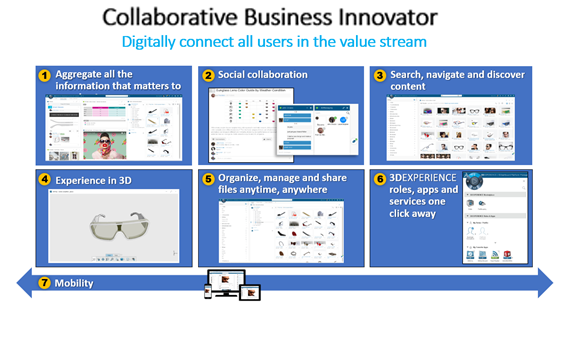
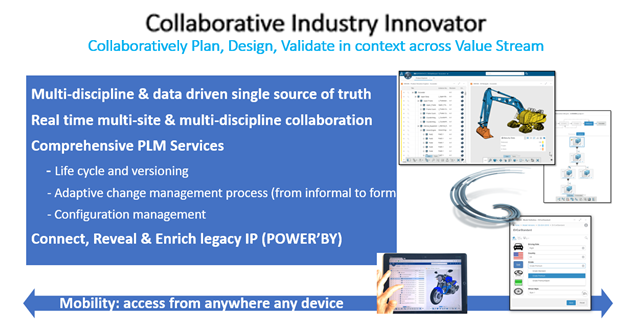
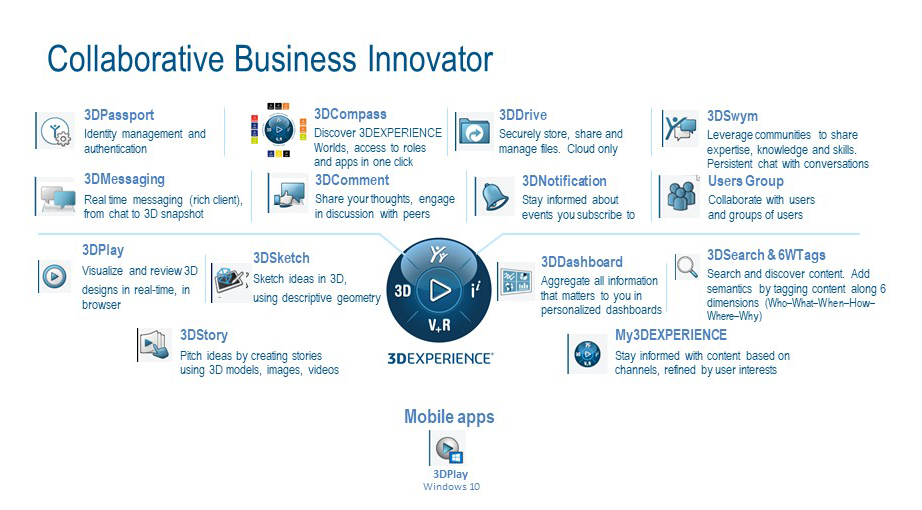
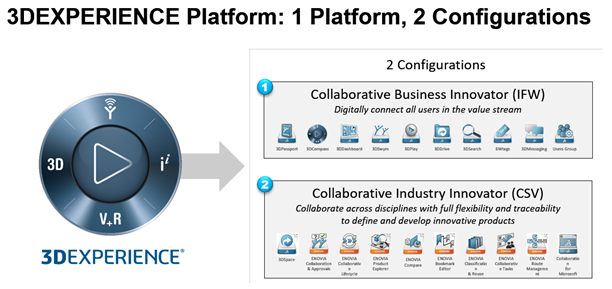
There are two configurations in Dassault Systèmes’ 3DEXEPRIENCE platform. They are Collaborative Business Innovator and Collaborative Industry Innovator. These configurations are explained in brief in the below infographics.

n1

n1

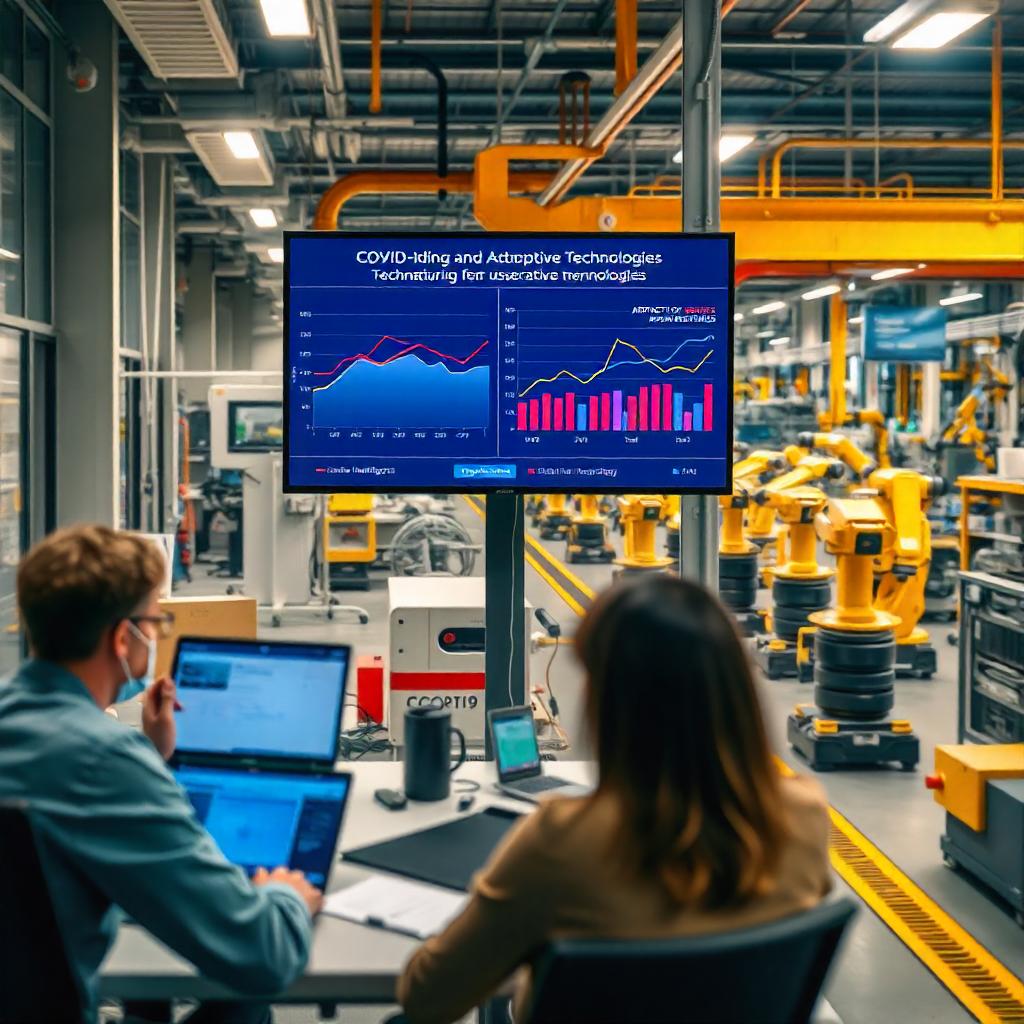
Impact of COVID – 19 & how it accelerated the adoption of disruptive technologies

The lockdown, necessitated by the spread of COVID-19 pandemic was beyond imagination. It made majority of the people restrict themselves to their houses. The traditional way of functioning in offices and organizations came to an abrupt halt. The important question in this situation was how to manage work and how to make sure business continues.

The pandemic and the eventual lockdown paved way for new technologies and new normal which had to be adopted. It is during this critical situation, many of the business firms started looking at cloud-based solutions as an alternative instead of traditional on-premise solutions which required physical presence of personnel at office premises to perform the assigned tasks.

The pandemic, in fact, accelerated companies in India to quickly adopt cloud-based solutions irrespective of their scale (be it medium or large enterprise). In some cases, companies adopted stage-wise and requirement-based cloud adoption and in other cases, they adopted cloud solutions fully.

According to one survey, more than 60% of Indian organisations plan to leverage cloud platforms for digital innovations as the firms re-strategize their IT infrastructure. Even though cloud was adopted by some organizations much before the pandemic, the current situation accelerated their transition towards cloud solutions – Infrastructure as a Service (IaaS), Platform as a Service (PaaS) and Software as a Service (SaaS).

i4
Dassault Systèmes’ 3DEXPERIENCE on Cloud solutions provide a complete suite of industry leading solutions in turning various innovative ideas into reality in the areas of design, engineering, manufacturing, production, simulation, governance and collaboration.

i4
The platform helps in connecting all the stakeholders of the organisation. Employees can access applications such as CATIA, SIMULIA, ENOVIA and DELMIA on the cloud and get the right data to work on as the platform provides access to the latest and updated data.

Dassault Systèmes’ 3DEXPERIENCE is the business solutions platform which enables companies to connect with their suppliers, customers as well as internal teams. This makes the feedback process from customers, work status updates by suppliers and internal teams quicker.

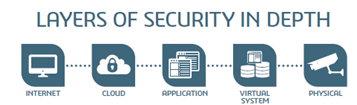
Will data security be compromised after adoption of cloud solutions?

Many companies are reluctant to deploy cloud-based solutions because of data security issues. To address this issue, the security processes of 3DEXPERIENCE on Cloud platform follows industry standards such as:

  • ISO 2700x standards and in particular Implementation Guide ISO 27002
  • NIST 800 series
  • OWASP methodologies
  • CobIT framework

i4
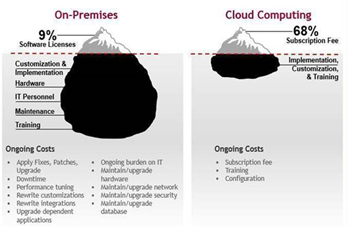
Will moving to cloud-based solutions increase my ROI?

Adoption of cloud-based solutions will drastically reduce the Total Cost of Ownership (TCO). Reduced TCO implies greater ROI. The below infographic shows how an organization can reduce costs by moving to cloud-based solutions.

i4
These benefits and security standards and the current pandemic situation make Dassault Systèmes’ 3DEXPERIENCE platform as the most secure and desirable platform by organizations.

How 3DEXPERIENCE On Cloud Adoption Helps Maintain Digital Continuity in Organizations

“Cloud” has been the buzzword for the past few years. Many companies have identified the upcoming business needs and challenges and have adapted by shifting to On-Cloud solutions. Decision makers need to be always connected digitally with the respective stakeholders.

The main conundrum now is that how can design and manufacturing be connected through cloud. Based on interactions with customers, some of the challenges perceived by them are listed below:

  1. How can digital continuity be maintained from RFQ to marketing and sales?
  2. How to connect service providers and respective stakeholders all the time by maintaining the same data connectivity?
  3. How to perform design, reviews, manage projects, conduct live digital meetings and so on?

Below are the 10 ways how the adoption of 3DEXPERIENCE On Cloud from Dassault Systèmes has helped customers tackle these challenges and maintain the digital continuity.

  1. 3DEXPERIENCE On Cloud provides a holistic real-time visibility of business to all stakeholders connecting people, ideas, data and solutions in a single collaborative and interactive environment.
  2. Cloud enables everyone involved in the project to interact, imagine, design, simulate and deliver.
  3. With the help of Cloud, collecting, importing and sharing project data can be done immediately to the respective team. Data can be stored in 3DSpace, a centralized server of Dassault Systèmes maintained by Amazon Web Services.
  4. Assigning and managing tasks or projects between different stakeholders and tracking the projects through web can be done by Cloud.
  5. Design reviews can be done on the fly irrespective of the location.
  6. Using Market Place and Part Supply accessibility, order can be sent to the certified suppliers or vendors.
  7. The Cloud solution is cost effective and provides immediate access to users.
  8. Cloud is adaptable, flexible and scalable with automatic updates.
  9. It enables faster collaboration by enabling accessibility anywhere, anytime and on any device.
  10. It is secure with protected environment.


The cloud-based 3DEXPERIENCE platform provides access to a growing portfolio of solutions that work together seamlessly. Some of them are discussed below in detail:

  1. Collaborative Business Innovator
    • Express innovative and creative ideas with communities seamlessly.
    • Digital connect with live dashboards assists in collaboration.
    • Can sketch and share ideas on the fly with the help of this solution.
    • Instant contribution makes the discussion more interactive and expedites decision making.

    x1

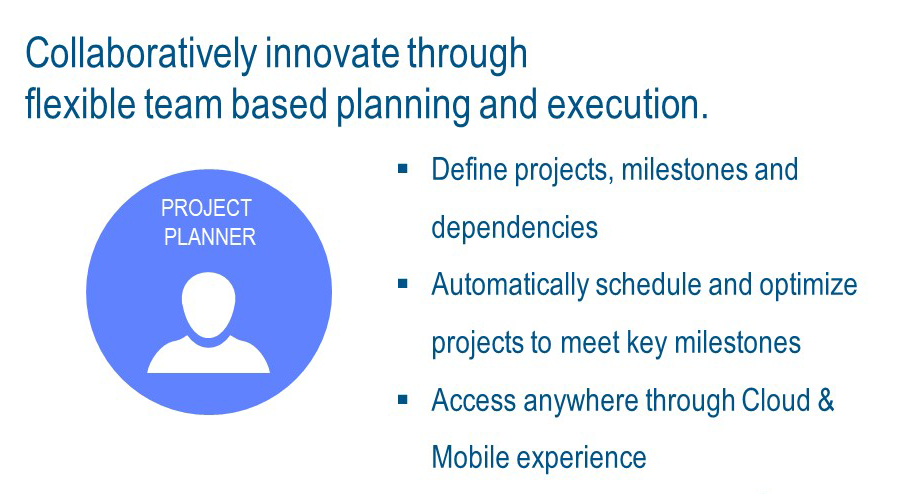
  1. Project Planner
    • Collaborative project planning with real time KPI monitoring.
    • Assign tasks to the respective users with deadlines and tracking the same with seamless integration.
    • Project planner dashboard can be accessed through mobiles, iPad and PCs anywhere anytime.

    x2

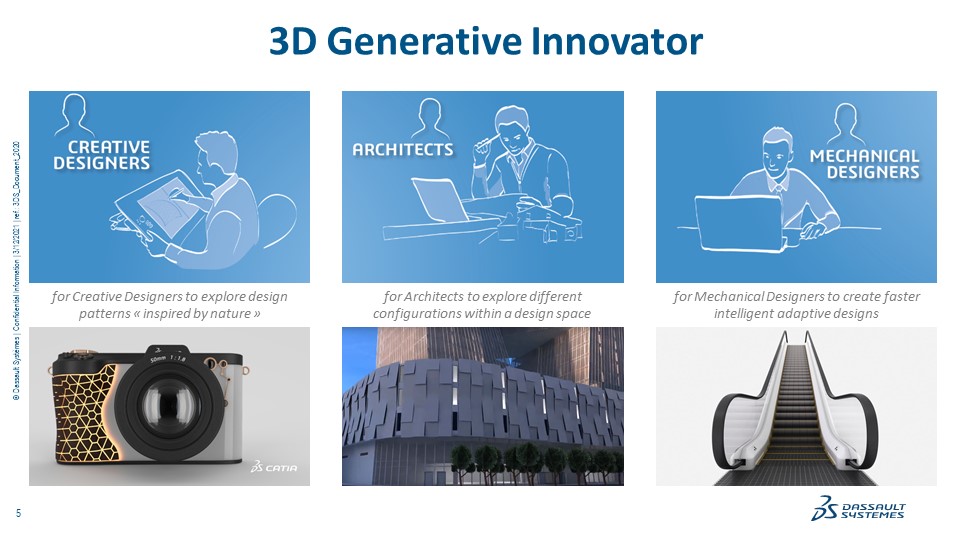
  1. 3D Innovator
    • Can do web based parametric design which helps to design anywhere, anytime and on any device.
    • Design and assemble parts, design guidance for topology, non-parametric optimization and accesibility to marketplace to 3D print the components.
    • Can manage complete PLM which improves efficiency, quality, productivity and innovation

    x3

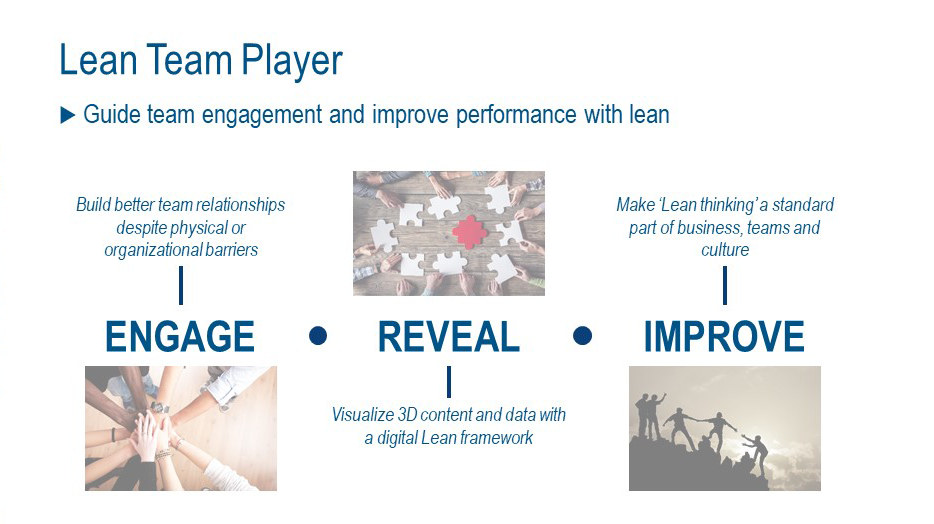
  2. Lean Team Player

    Manufacturing teams can conduct digital meetings, track with the inbuilt lean principles with virtual models, process and resources

    x2

Why Data Driven CAD is Preferred over File Based CAD

The need for PLM integration with CAD is one of the key concerns of any engineering company to stay competitive and launch the product in the market in a short duration.

If you are in the process of replacing your file-based CAD system with data-driven CAD, then Dassault Systèmes’ 3DEXPERIENCE platform is the way to go.

CAD blog1

3DEXPERIENCE platform boasts of distinct features like cloud based, data driven and all-in-one PLM experience which will ease any typical workflow and support faster go-to market strategy.

3DEXPERIENCE is available on Premise and also on Cloud. This eliminates file-based data storage which has an impact on real time digital continuity.

One of the unique values of having database driven CAD system is that it gives access to store the data in the server and thereby restricts saving it locally. All the stakeholders can access the data based on their roles which is assigned by the admin. It also allows external suppliers and customers to connect to the platform, access relevant data, collaborate and accomplish the task thereby expediting decision making.

CAD blog2

Often many projects get delayed or overshoots budget because of the discontinuity of the digital data flow. The major advantage of a data driven platform is to access a “single source of truth” which means if any data is modified, then it is available for all the stakeholders in real time. They will always have the access to updated data.

Imagine that there are multiple work locations and team members working on the same project. Any changes in part or assembly will automatically be updated to all the stakeholders no matter where they are working.

Analysis is one of the crucial areas which can accelerate the product launch. More often, products are validated in a digital platform instead of a physical test. In this scenario, design data should be imported to analysis software and any change in the design has to be communicated to the design team. Once the design changes are done, the design team needs to push data to analysis software manually. This process often leads to data loss and is also time consuming. However, with 3DEXPERIENCE platform, all the stakeholders of the project (analysis team is also one of the stakeholders) can get real time data without any data transfer out of the platform. Since the data is stored in server, all the users will have access to the latest data with respect to the assigned project.

The CATIA 3DEXPERIENCE platform is much more than a CAD software. It also manages end-to-end workflow, deliverables and project deadlines. Since the platform is data driven, project managers can access all the data which is related to the project and make better decisions so as to accelerate the product launch to the market.

3DEXPERIENCE has two different interfaces: web and native interface. Social, collaborative and information intelligence apps will work in web interface without any installation. The native apps however require installation. All the 3D modelling and simulation apps such as CATIA, SIMULIA and DELMIA are part of native apps.

Today the market is more demanding and competitive. 3DEXPERIENCE will definitely help companies to stay competitive and create sustainable growth.

Material Calibration in 3DEXPERIENCE Platform

What is Calibration?

Calibration is the comparison of measurements with a standard, accurate reference. The mathematical material model is generally defined using equations. This mathematical model represents the response of the material, constitutive behaviour and parameter dependency for material behaviour. Material calibration techniques helps to achieve optimum, best fit or closest value of material laboratory test data concerning the actual material behaviour. In this blog, material calibration capabilities of 3DEXPERIENCE platform are discussed in detail.

Why Material Calibration?

The main reason behind material calibration is to avoid the challenges and lengthy process of advance material modelling in Finite Element Analysis. For example, in the case of hyper-elastic materials generally, we have laboratory test data so as to understand which strain energy potential or coefficient would be best suitable. In such a scenario, material calibration will be of help.

The manual calibration process is time consuming, difficult and might not be accurate which might lead to errors whereas the calibration process in 3DEXPERIENCE uses similar data points which are obtained during laboratory tests. It will also capture proper behaviour and reduces errors between test data and material model.

General Process of Calibration:

  1. Import the Test Data
  2. Select the material model and apply various filters
  3. Execute the calibration process

Calibration example using 3DEXPERIENCE platform:

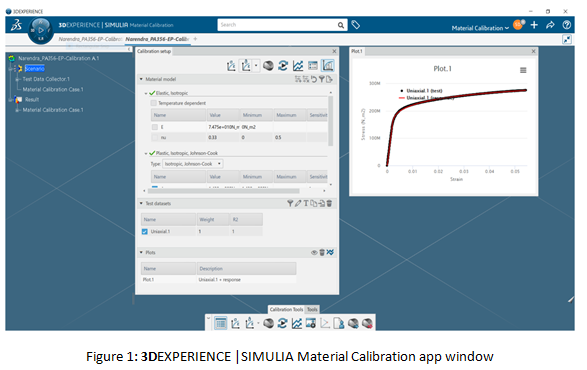
img1

The above window shows the Calibration tab and other tab is about the imported test data. Calibration tab consists of several settings to work smoothly on imported data.

Importing and processing Test Data:

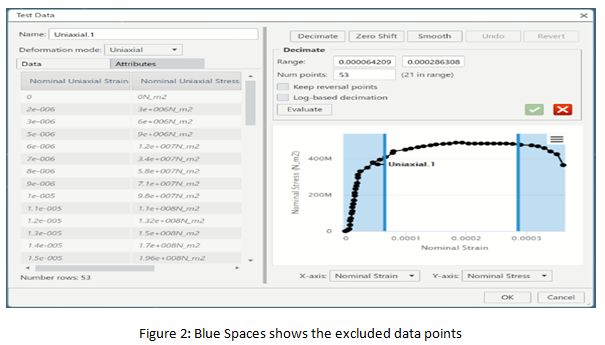
Material can be imported from CSV, XLS and text format. Units and time have to be defined and temperature can be used if needed. Input data can be processed using decimation, smoothing and zero shift option. If many data points are used, then there are chances of errors or increase in execution time. In such a scenario, decimation option can be used to define the range of data to choose for execution by defining upper and lower limits just by dragging through the plot area.

img2

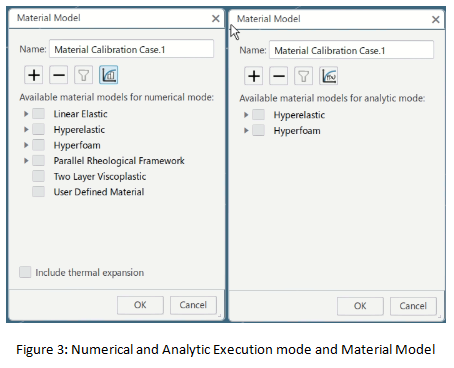
Further, material model needs to be selected and the model depends on execution and numerical modes. For example, available models for numerical modes are linear elastic, hyper elastic, hyper foam, parallel rheological framework (including two-layer visco plastic) and user defined material. Analytic mode offers hyper elastic and hyper foam models.

img3

Execution mode covers variety of material models of which most of them are implemented in Abaqus. Numerical mode generally takes more time to execute over analytical but it calibrates the material as accurately as possible. Since it uses Abaqus code material subroutine, it may be slower but it covers large number of material models and is efficient. Analytical mode is faster as it uses built-in equations of mathematical models.

Correction of Imported Data:

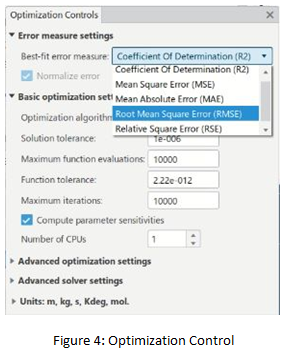
Correction of imported data can be done through various error measure settings such as:

  1. Coefficient of Determination
  2. Mean Square Error
  3. Mean Absolute Error
  4. Root Mean Square Error
  5. Relative Square Error

img4

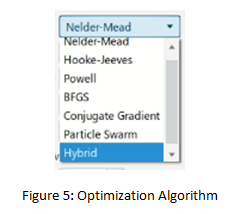
Along with error measure settings, there is also flexibility to choose optimization algorithms, solver settings and selection of units.

img5

Executing, Saving and Exporting Material Model:

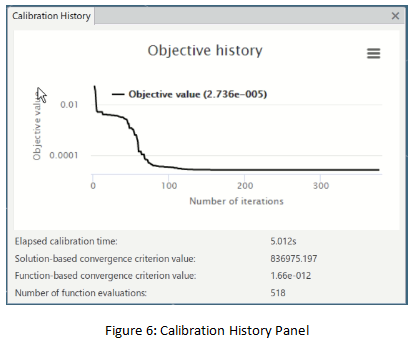
Once the optimization control is done, material model is finalized for execution. It is possible to enter the initial and known value for material model but not necessary. Once the execution is completed, the calibration history panel appears and the selected material parameters are also updated in the calibration setup panel.

img6

The final result can be saved in the material pallet by creating a new material so that it can be used in 3DEXPERIENCE platform as and when required. Also, if execution in Abaqus is required, then the pallet can be exported as .inp file but unit selection must be done prior to exporting the data.

Conclusion:

The 3DEXPERIENCE – Material Calibration apps offer many options to calibrate the material model, specifically the new and complex material models such as hyper elastic, non-linear viscoelastic material and prony series. It is definitely a choice for faster and error free calibration.

Subscribe to our newsletter

Get all the latest information on Events, Sales and Offers.